Spark for Teams is where the mail app takes on a whole new life. The team behind Spark hasn't just built a convincing email app—they've developed a collaborative email platform. This includes unique features like the ability to comment privately with team members on email in a small chat box to the right of the message. Read reviews, compare customer ratings, see screenshots and learn more about Spark - Email App by Readdle. Download Spark - Email App by Readdle for macOS 10.13 or later and enjoy it on your Mac. Spark is the best personal email client and a revolutionary email for teams. Spark Mail App For Mac By petcutesimp1976 Follow Public While in Inbox emails are automatically sorted in bundles for common message types such as purchase receipts and travel updates, Readdle built a Card system for Spark, limiting it, however, to three types of messages.
Spark works with Gmail, iCloud, Yahoo, Exchange, Outlook, Kerio Connect, and other IMAP email accounts.
The first email account you add to Spark becomes your email for sync. When you want to use Spark on a new device, log in with this address. Your personal settings, added accounts and all emails will be synced automatically. To find out more about sync and how it works, check this article.
- Launch Spark on your Mac and click Start Using Spark.
- Enter your email address.
- Tick I agree to the Spark Privacy Policy and Terms of Service.
- Click Next.
- Follow the onscreen instructions of your email provider to sign in.
Note: If you want to connect to an iCloud account, you need to add the email address which ends with @me.com, @iCloud.com, or @mac.com and generate and enter an app-specific password to log in.
- Your email provider will ask if you allow Spark to access your account. Tap Allow or Agree.
- Click Start Using Spark. Now, your account is connected to Spark.
- Launch Spark on your iPhone or iPad. On the welcome screen, tap Skip or Got It.
- Enter your email address.
- Tick I agree to the Spark Privacy Policy and Terms of Service.
- Tap Next.
- A login screen of your email provider will appear. Follow the onscreen instructions to sign in.
Note: If you want to connect to an iCloud account, you need to add the email address which ends with @me.com, @iCloud.com, or @mac.com and generate and enter an app-specific password to log in.
- Your email provider will ask if you allow Spark to access your account. Tap Allow or Agree.
- Tap Start Using Spark. Now, your account is connected to Spark.
- Launch Spark on your smartphone. Tap Skip or Got It on the welcome screen.
- Enter your email address.
- Tick I agree to the Spark Privacy Policy and Terms of Service.
- Tap Next. If you use a Gmail account, you can choose Sign in with Google.
- A login screen of your email provider will appear. Follow the onscreen instructions to sign in.
Note: If you want to connect to an iCloud account, you need to add the email address which ends with @me.com, @iCloud.com, or @mac.com and generate and enter an app-specific password to log in.
- Your email provider will ask if you allow Spark to access your account. Tap Allow or Agree.
- Tap Start Using Spark. Now, your account is connected to Spark.
You can add more Email accounts to Spark.
Choose the account name, title, and color
- Click Spark at the top left of your screen.
- Click Preferences > Accounts and select your account.
- Type your name in the Name: field. The name is displayed in the To: or From: field when you send or receive an email. If your account has no name, these fields are filled with your email address.
- Fill out the Title: field. The title is used only in Spark. This is the name of your account shown on the left sidebar. You can enter any title you wish to navigate your inbox easily.
- Click on the Color setting to choose the color for your account. For example, you can pick red for your work account and use green for personal emails. It allows you to see which account each email in your inbox belongs to.
Note: To enable color coding for accounts, open Preferences > General > Appearance and make sure the Color Coding for Accounts option is ticked.
- Tap the menu icon at the top left.
- Open Settings > Email Accounts.
- Tap the needed account.
- Write your name in the Name: field. The name is displayed in the To: or From: field when you send or receive an email. If your account has no name, these fields are filled with your email address.
- Fill out the Title: field. The title is used only in Spark. This is the name of your account shown on the sidebar. You can enter any title you wish to navigate your inbox easily.
- Tap Account Color and choose a color for your account. For example, you can pick red for your work account and use green for personal emails. It allows you to see which account each email in your inbox belongs to.
- You can also customize Notification Type here: tap the needed email account and Tick one of the notification types: All, Smart, No Notifications. To learn about notifications in Spark, check this article.
- Tap the menu icon at the top left.
- Tap Settings .
- Choose Mail Accounts.
- Tap the needed account.
- Write your name in the Name: field. The name is displayed in the To: or From: field when you send or receive an email. If your account has no name, these fields are filled with your email address.
- In the Title: field, write the name of your account. The title is used only in Spark. This is the name of your account shown on the top of the sidebar and in the mail accounts settings.
- Tap Color Coding and choose a color for your account. For example, you can pick red for your work account and use green for personal emails. It allows you to see which account each email in your inbox belongs to.
Note: To make sure coding for accounts works properly, open Settings > Mail Accounts > Color Coding and enable the toggle Color Coding for Accounts.
Read next:Add More Email Accounts to SparkOver the last few years, email has become an integral part of our daily lives. It has evolved from a simple way to send and receive text between two parties into a familiar and reliable method of communication that can be used as a place to receive newsletters, updates, and notifications from various services, etc. Several email apps have built additional features and experiences on top of the core email technology, such as shared inboxes, team collaboration, delegation, inline comments, etc.
Finding an email client for your Mac is not a trivial task. There are numerous free email apps for Mac that are released every few months and many simply shut down or disappear just as easily. Thankfully, we’ve made it easy for you by picking some of the best email apps out there and highlighting everything you should know about them. By the end of this article, you’ll emerge fully aware why Readdle’s Spark is by far the best email app for Mac.
Here’s our roundup of all the good email clients available for macOS:
Spark Email App
1. Apple Mail app
Pricing: Free
Pros: Good set of basic features, well-integrated with the OS, great for starters.
Cons: Lacks advanced features, no customization options, often ignored by Apple.
It’s nearly impossible to talk about the best email apps for Mac and not include Apple’s own Mail.app in the list. Apple Mail is a reliable & solid email app for Mac that is a great option for someone just starting off with email. It comes bundled with macOS and integrates well with the major email service providers. Mail app works best when used with iCloud and automatically sets up the iCloud email account when you set up your iCloud account on your Mac.
It has a basic set of features that are good enough for novice users to get started with the essential email experience. If you’ve just switched to a Mac from a PC, you’ll find the Apple Mail app experience far better than anything you’ve previously used from Microsoft. But you’ll quickly realize that Apple Mail lacks the essential email features that are must-have in today’s day and age and you’ll find yourself searching for the best Apple Mail alternative on Mac.
2. Microsoft Outlook for Mac
Pricing: Free to download, but requires a Microsoft 365 Subscription starting $70/year
Pros: Comes bundled with other Microsoft apps, Built-in Calendar, Dark Mode
Cons: Expensive in the long run, cluttered User Interface, unfamiliar design language on Mac
Microsoft Outlook for Mac is what Apple Mail would be if you threw in a bunch of features and made it look like every other Microsoft app. Unlike the Outlook Mail app on iOS which is praised by many, Outlook for Mac feels like a cluttered mess designed by a team of programmers 10 years ago. It is, however, packed with several great email features. Outlook has what it calls a Focused Inbox, which automatically sorts your important or personal emails into the Focused tab and separates the rest of the junk like newsletters and marketing emails into a separate tab.
Outlook comes bundled with a Microsoft 365 subscription that gives you access to Word, Excel, Powerpoint, OneNote, and OneDrive, so if you use any of these apps on your Mac, you can easily start using Outlook for Mac over Apple Mail and take advantage of all its good features. It works with email services like Gmail, Yahoo, iCloud and pretty much anything that supports POP3 or IMAP protocols (I’m looking at you HEY Email). However, if you want a Mac email client that has both a beautiful design & a feature-rich approach, you have to look no further than Spark.
3. Spark
Pricing: Free for Individuals & Small Teams, with optional Premium plans for teams that require more features
Pros: Beautiful & polished design, elegant aesthetics, feature-packed, multi-platform, several team-focused features, great for collaboration.
Cons: Lacks a Windows app (currently in development)
Spark is a beautifully designed and feature-rich email client from the house of Readdle, known for their suite of productivity apps for iOS and Mac. Spark offers a distraction-free email experience through a delightful interface and a very powerful set of features. It works with all major email services like Gmail, iCloud, Yahoo, Hotmail, Aol, GMX, Exchange, as well as any IMAP account.
Spark features a Smart Inbox that automatically sorts incoming email in collections of Personal email, Notifications, and Newsletters. This lets you focus on all the important emails first, while the rest of the clutter takes a back seat. This, coupled with the Smart Notifications feature that only alerts you about the important emails is a great way to take control of your inbox and get productive.
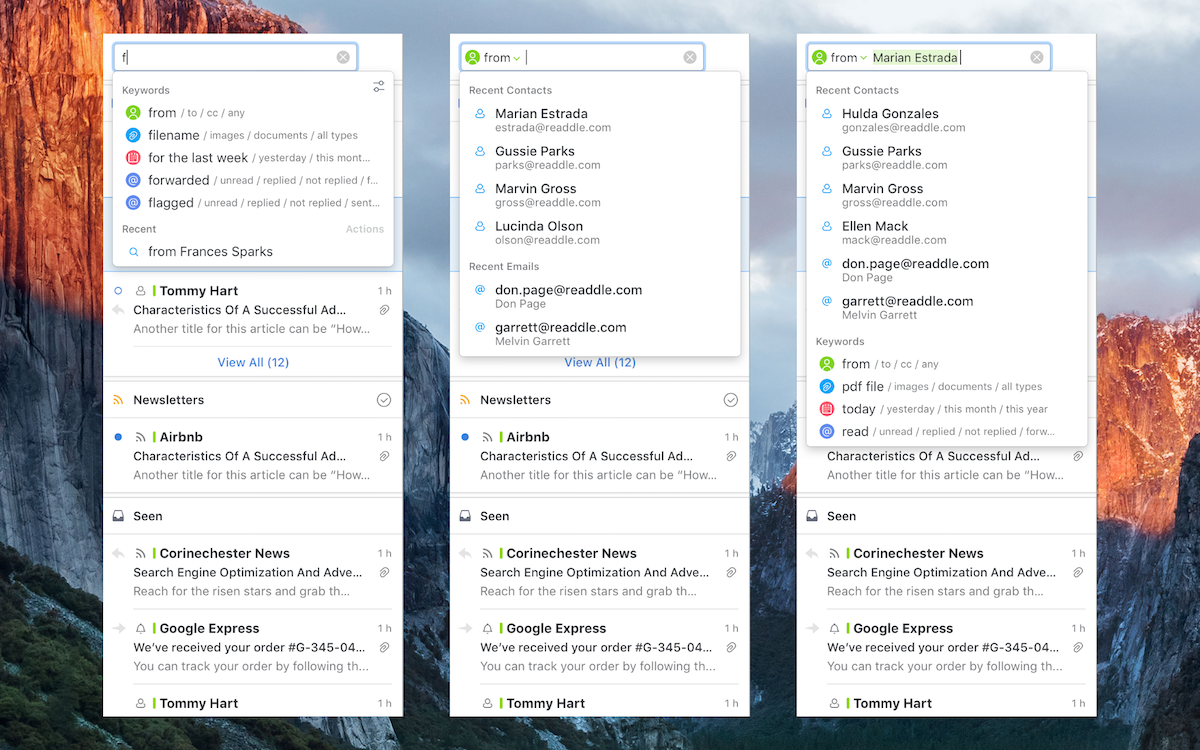
Spark comes with a smart & robust email search feature using which you can locate any email buried deep down in an instant. Simply search for what you’re looking for using Natural Language Search terms and Spark will find it for you. Type “Attachments from Nick” to search for all emails from Nick that have attachments in them, and “PDF attachments from David sent last week on Monday” to bring up all those emails from last Monday from David that have PDF files in them. You can even save your frequent searches, so locating those emails is just a click away.
If you don’t feel like attending to an email right away (such as bill reminders or upcoming renewal notifications), you can set the email aside temporarily using the Snooze feature and reduce the clutter in your inbox. You can schedule emails to be sent later, get reminded to follow-up if you don’t get a response by a stipulated deadline, integrate with a bunch of different apps & services, and so much more. Spark has all the features you need to work with email.
One area where Spark really shines is Spark for Teams. Invite your team members to Spark to collectively work on email together. Spark for Teams lets you Delegate emails — complete with a due date, Share & Discuss email with teammates with inline comments, collaborate on email with a real-time editor on Shared Drafts and share your emails with teammates without manually forwarding them and cluttering up their inboxes.
Overall, Spark is a remarkable bundle of all the features you need to work with email. It’s a fantastic email app for Individuals, and even better for teams. You don’t have to deal with two different versions — the same Spark app is the best Mac email client for personal use and adapts itself with built-in features to become the best email app for teams as well.
Best of all, Spark is absolutely free, so you really have no reason to miss out on the wonderful experience that Spark has in store for you.
4. Airmail
Pricing: Free, but requires a Recurring Subscription of $2.99/mo for Pro features
Pros: Loaded with features, fast, and has a Unified Inbox.
Cons: Messy UI that feels like it was hastily put together, requires Pro subscription for most features.
Airmail is a popular email client available for macOS that boasts of several features in its satchel. It supports all the popular email service providers including Exchange, as well as accounts with IMAP or POP3 access. Just like in Spark, there’s an Unified Inbox feature that lets you view emails from all your accounts in one place.
If you have a Mac notebook with a Touch Bar, Airmail puts your frequently used actions on it so that they’re just a tap away. You can, of course, customize these actions with your favorite set. There’s a lovely Dark Mode to help you with the night sessions, Quick Replies for short responses, a Today Widget to get a quick overview of your inbox, and a handy Share Extension so you can instantly email anything using Airmail.
Overall, Airmail is a really good email app for macOS, and would do really well if it wasn’t for its messy UI and it’s requirement of a recurring subscription of $2.99/mo for Pro features that hasn’t gone down well with its users.
5. Mailplane
Pricing: $30
Pros: Brings the familiar Gmail experience with a native interface
Cons: Only works with Gmail, often breaks due to changes by Google
If you have multiple Gmail accounts that you use simultaneously, Mailplane is the app you need to have on your Mac. Simply put, Mailplane is a native Mac app that wraps around the familiar web interface of Google’s products. With Mailplane, you get Gmail, Google Calendar, and Google Contacts — all in the same application. You can use multiple accounts in the app, and you can mix and match the accounts & services. For example, you can have Tab 1 for your personal Gmail account, Tab 2 for your G Suite for Work account, and Tab 3 for your Work Calendar account.
Mailplane has a handy notifier that not only alerts you about new emails, but also shows unread messages count in the menu bar. It has a ‘Search Everywhere’ feature that lets you simultaneously search for emails across different mailboxes. It also seamlessly integrates with a bunch of different macOS apps. My favorite Mailplane feature is that since it is essentially a browser for Google’s web UIs, it supports most of the popular third-party extensions to enhance your experience. You can enable Grammarly to improve your language, Simplify/Gmail to clean up the Gmail UI, Boomerang for Gmail to power-up features, Clearbit to add context to email addresses, and so on.
Spark Email Ios
Unfortunately, your experience is still plagued with issues as Mailplane has to depend on Gmail’s web UI for it to work correctly and oftentimes it just fails to load Gmail, asking you to load an basic HTML version instead. You’ll also often be annoyed by Gmail asking you to enter your account credentials to verify yourself if you use too many accounts in Mailplane. To avoid these hassles, you can set up multiple Gmail accounts in Spark for Mac. This way, you get a premium native email experience and you also have access to your Google Calendar and contacts at your disposal.
6. Canary Mail
Pricing: $20
Pros: Good design, with heavy focus on Security & Privacy
Cons: Lacks Team features
Spark Email App Mac
Canary Mail is another email app for macOS that puts a heavy focus on privacy and security. It features end-to-end encryption, full PGP support, and an open source mail sync engine, making it a good choice for users who rely on PGP for all their email communication.
Canary has a beautiful design that looks like any other native Mac app built by Apple. There are familiar icons and buttons in the Mac app, and the UI is built to be simple yet powerful. It’s almost like the default Mail app on steroids.
While Canary is a pretty good email app for personal use, it lacks team collaboration features that are the need of the hour today. If you need to discuss emails with your team, need to draft emails together, and want to share emails without manually forwarding them, then Spark Mail app is what you really need.
7. Newton Mail
Pricing: Recurring Subscription of $49.99/yr
Spark Email
Pros: Multi-platform, Minimal & elegant design
Cons: Expensive subscription with an unclear future
Newton mail is an immensely popular email app that has spent quite some time in the news cycle lately. The app has an extensive set of features that make it an attractive choice for normal and pro users both. Newton features a very minimalistic user interface that takes the clutter out and lets you focus on the core email experience. Unfortunately, the UI is a little too minimal for many who are bothered by the empty spaces in the app.
Spark Mail App Download
In recent times, Newton has managed to alienate its loyal users after it announced that it is shutting down, two times in a row. The first time, the original owners of Cloudmagic announced that they were shutting down Newton, only to be bought over by Andy Rubin’s phone company Essential. Then for round #2, when Essential was shutting down, they announced that Newton would meet its end as well, only to be brought back by two independent fans of the service who didn’t want to see it die. As of now, there’s no clear future for Newton, especially considering that the service is priced at a hefty $50 per year.
Spark For Mac
When pitted against all the popular email apps for Mac available in the market, Spark Mail app emerges as the best email app for Mac by a long margin. It has the absolute perfect combination of a friendly & elegant user interface along with an extensive & robust set of features. Coupled with its impeccable polish, seamless integrations, phenomenal team features, and highly impressive price of being available for free, there’s really nothing that comes close to being a viable contender. Spark is truly the best email client for Mac.